


The Information: Tech News
4.035.00 Reviews
App Specs
- Version
- 3.0.6
- Updated On
- License
- Free
- Downloads
- 50,000+
- Developer
- The Information
- Categories
- News & Magazines
- Platform
- Android
Screenshots


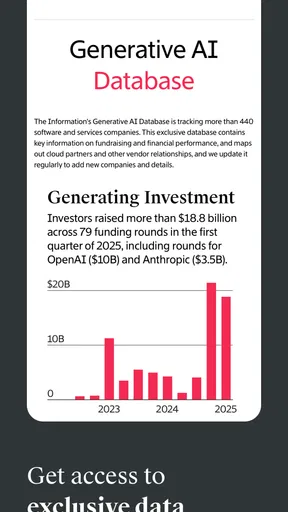
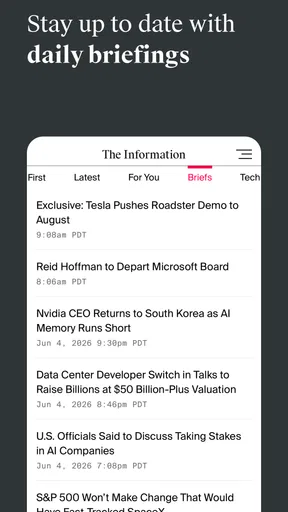

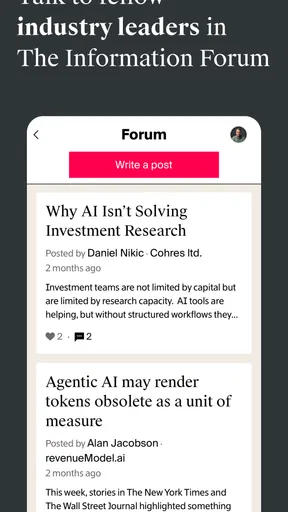

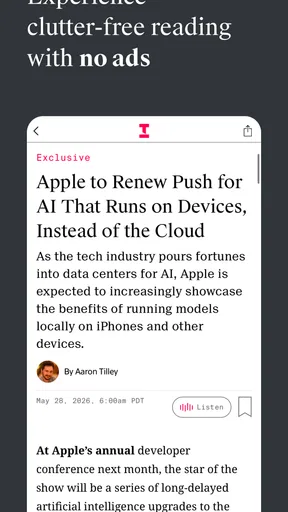
 Analysis by AppCompare
I found The Information: Tech News most interesting when I stopped treating it like a general news reader and used it as a focused briefing tool. Its purpose is narrow: it follows the business and technology stories that matter to people watching artificial intelligence, venture capital, startups, semiconductors, and cryptocurrency. That focus changes the experience. Instead of opening an app to browse everything happening in the world, I open this one when I want to understand where the technology industry is moving and why a particular company or market suddenly matters.
The app comes from The Information and sits in the News & Magazines category. It is free to install, has an Everyone content rating, and runs on Android devices using version 7.0 or later. Its current version is 3.0.6, while the app itself was released on December 2, 2019. Those details make it accessible to a wide range of Android users, although the free download should not be confused with unlimited access to every part of the publication.
Why the focused technology briefing matters
The capability I kept returning to is the app’s concentrated coverage of technology business news. That sounds simple, but it has a practical effect: the reading experience is shaped around professional context rather than broad headlines. A general news app may tell me that a startup raised money, a chip company changed direction, or an artificial intelligence product launched. Here, I am looking for the surrounding questions: what kind of company is involved, who may be affected, what does the move reveal about the sector, and why should an executive, founder, investor, or technology professional care?
I would not use it as my only news source. It is not designed to replace a broad newspaper app, a local news service, or a general-purpose feed. Its value comes from reducing the distance between an event and its business meaning. If my work depends on following technology companies, that narrower lens is more useful than a stream filled with unrelated headlines.
The app’s store summary points directly toward exclusive reporting in AI, venture capital, startups, semiconductors, and crypto. I found that positioning helpful because it sets the right expectation before installing it. This is not a casual collection of gadget announcements. It is better understood as a specialist publication delivered through a mobile app, with the phone acting as the convenient place to check the latest reporting and return to stories during the day.
That distinction also explains why the app may feel less rewarding to someone who only wants quick entertainment or a selection of general headlines. The subject areas overlap with mainstream technology coverage, but the intended reader is someone who wants to follow companies, funding, products, infrastructure, and markets as connected parts of one industry.
Turning headlines into useful context
One of the less obvious benefits of a specialist app is that it can help me build a mental map over time. Reading one isolated technology headline rarely teaches me much. Reading related coverage across startups, investors, chips, and AI can reveal how those areas depend on one another. A change in computing hardware can affect AI companies; funding conditions can affect hiring and product plans; a crypto development can matter differently to a financial company than to a software founder.
Worth Reading Before You Choose

EA SPORTS FC Mobile 26 Is a Bigger Football Game, but It Takes Time

Flipboard Shows What News Apps Must Do Beyond the Feed

Switching to Android Auto Means Rethinking Your Driving Routine

Google Calendar Makes a Crowded Week Easier to Manage

Ludo King Makes the Most of the Minutes Between Plans

Baby Panda World Brings Quick Play to Modern Phones, but Its Game Library Feels Busy
I found this especially useful when I wanted to prepare for a meeting without spending the whole morning searching several websites. The app’s subject focus gave me a starting point for deciding which stories deserved deeper attention. I could read for orientation first, then use other sources when I needed technical documentation, local reporting, public filings, or a wider political perspective.
The real strength is not simply speed; it is the editorial filter that helps me decide what deserves attention. That is a more valuable capability than an endless stream of articles, particularly for readers who already know the basic vocabulary of the technology industry and want sharper business relevance.
What using it feels like in practice
My practical routine was straightforward. I opened the app when I had a few minutes, scanned the technology stories that looked closest to my interests, and chose one topic to follow rather than trying to consume everything at once. That approach works better than treating the app like a social feed. The subject matter rewards concentration, and I got more from a small reading session when I approached it with a question in mind.
For example, I might begin with a question about whether a new AI development is mainly a product story, a funding story, or an infrastructure story. A general news reader often presents those as separate items. A specialist source is more useful when I want to connect them. I could read the relevant report, note the companies and investors involved, and then decide whether the issue was important enough to investigate elsewhere.
This makes the app suitable for short, repeated visits rather than one long browsing session. I could check it before work, return during a break, and use a later reading session to revisit a topic with more context. The workflow is more like maintaining awareness than completing a daily checklist.
Another practical point is that the app is not equally valuable for every kind of technology question. If I wanted instructions for setting up a device, a comparison of consumer phones, or a troubleshooting guide, I would choose a different resource. The Information’s focus is strongest when the question concerns the technology industry as a business: companies, capital, strategic decisions, and the markets around them.
A realistic workday use case
Imagine that I work at a software company and have a meeting about an AI partnership later in the afternoon. I do not need a complete history of artificial intelligence, and I do not want to sort through unrelated global headlines. I want a compact way to understand the current conversation around AI companies, investment, computing supply, and competitive positioning.
I could use the app during a commute or coffee break to identify the stories most relevant to that meeting. The useful step is not copying a headline into my notes. It is asking what the article changes in my understanding. Does it suggest that a company is prioritizing infrastructure? Does it show that investors are shifting their attention? Does a semiconductor development make a software plan more realistic or more difficult? Those questions turn reading into preparation.
Afterward, I would still verify anything important through primary material or another independent source before making a business decision. The app can improve my awareness and help me find the right questions, but a news article should not be the sole basis for investment, legal, technical, or employment decisions. That is not a weakness unique to this app; it is a sensible boundary for specialist journalism in general.
Where the free entry point helps
The free price makes it easy to test whether this focused approach fits my habits. I did not need to commit before learning whether the subject areas matched my interests. That matters because specialist news is personal: one reader may find semiconductor coverage essential, while another may care only about startups or AI.
At the same time, the app includes in-app purchases ranging from $2.99 to $499.99 per item. I would treat that range as a reminder to check the subscription or purchase screen carefully before confirming anything. The free installation is a low-risk way to explore the app, but readers should understand what access they are receiving and what a paid option unlocks before proceeding.
For me, the sensible approach is to begin with the free experience, establish a real reading routine, and only then decide whether the deeper access justifies the cost. Someone who checks technology news once a month may not gain enough from paying. A founder, executive, analyst, or investor who uses the reporting repeatedly may judge the value differently.
Tradeoffs that became clear
The first tradeoff is breadth versus relevance. Because the app concentrates on a small set of technology sectors, it saves time when those sectors are exactly what I need. But that same focus means I may miss important context from economics, regulation, science, labor, international affairs, or local business reporting. I would pair it with a broader news app rather than expecting it to cover the whole day’s information.
The second tradeoff is depth versus casual reading. Specialist reporting can be more useful than a short headline, but it also asks more from me. I need to pay attention to the companies, funding relationships, technical terms, and business consequences. If I only have the energy for quick summaries, a general technology feed may feel easier.
The third tradeoff concerns access. The app is free to download, yet its purchase options mean that the most useful experience may depend on the level of access I choose. That can be reasonable for professional journalism, but it makes the app less attractive to readers who expect every article in a free app to be available without a paid decision.
There is also a risk of becoming too dependent on one editorial lens. A focused publication can help me avoid noise, but it can also shape which stories I notice. I found the best balance by using the app for industry intelligence and a separate broad source for public-interest context. That combination gave me both specialization and perspective.
Who gets the most from it
The strongest audience is made up of people who need to track technology companies as part of their work or serious personal interests. Startup employees can use it to understand competitors and funding patterns. Founders may find it useful when preparing for conversations with investors or partners. Executives can use it as a compact way to stay aware of changes across AI, chips, crypto, and venture capital. Students and job seekers may also benefit if they want to learn how the technology industry is discussed beyond product launches.
It can also help a curious reader who is tired of shallow technology headlines but does not want to build a daily reading list from scratch. The app gives that person a defined place to begin. I would recommend taking notes on recurring companies and concepts rather than reading passively. Over time, that makes the coverage more valuable because new articles have somewhere to fit in my understanding.
On the other hand, I would skip it if my main interest is consumer buying advice, app recommendations, gaming news, local events, or broad world news. I would also hesitate if I rarely read technology business coverage or dislike articles that require background knowledge. In those situations, a general news service, a consumer technology publication, or a free headline reader would probably offer better value.
The app has an average rating of 4.0 from around 259 ratings, with around 35 written reviews, and it has passed 50K installs. I read those figures as signs of a focused product with a defined audience rather than a mass-market news utility. That matches my experience: its usefulness depends much more on whether its editorial territory overlaps with my daily questions than on how many unrelated features it offers.
My advice before committing
I would start by identifying the topic that brings me to the app most often. If it is AI, I would notice whether the surrounding startup, capital, and semiconductor coverage adds useful context. If it is venture capital, I would ask whether the reporting helps me understand company strategy rather than merely funding announcements. If crypto is my main interest, I would compare the app’s business-focused perspective with a specialist market source before deciding whether it is enough on its own.
I would also avoid measuring the app by the number of articles I read. A short, relevant briefing can be more useful than dozens of disconnected updates. The better test is whether I leave with a clearer view of what changed, who is affected, and what question I should investigate next.
Finally, I would review the purchase details with care. The app costs nothing to install, but the available in-app purchases span a very wide range, from $2.99 to $499.99 per item. I would choose only after understanding the access period and terms displayed in the app, especially if I am installing it for work or sharing a device with someone else.
After using it as a specialist briefing companion, I see The Information: Tech News as a good fit for readers who want technology business reporting with a clear editorial center. I like it because it helps me spend less time hunting through unrelated headlines and more time connecting developments across AI, startups, venture capital, semiconductors, and crypto. Its limitations are equally clear: it is not a complete news service, and the paid access structure deserves attention.
My recommendation is positive but specific. Install it if technology companies and their business decisions are part of your work, study, or serious interests. Use it alongside broader and primary sources, and judge it by whether it improves your understanding rather than simply filling spare minutes. For the right reader, that focused capability is the reason to keep it; for everyone else, a general news app will likely be the more practical choice.
Pros
- Covers technology news
- gadgets
- science
- and digital culture in one app.
- Articles are generally quick to scan during short breaks.
- Useful for following major tech stories without visiting several websites.
- Clean presentation keeps headlines and story categories easy to browse.
- Offers thoughtful reporting beyond simple product announcements.
Cons
- Some stories may feel more opinionated than strictly news-focused.
- The app can be less useful for readers seeking highly specialized tech coverage.
- Article availability and update frequency may vary by news cycle.
- Certain content may require an active subscription or account.
- Notifications can become distracting if too many topics are enabled.
FAQs for The Information: Tech News
What is The Information: Tech News?
The Information: Tech News is a subscription-based news app focused on the technology industry, startups, venture capital, business strategy, and influential companies. It is designed for readers who want detailed reporting and analysis rather than short headlines. The app brings articles, investigations, newsletters, and other editorial content into a mobile reading experience for keeping up with important developments in tech.
Is The Information: Tech News free to download and use?
The app may be available to download without an upfront charge, but access to most or all of its premium journalism generally requires a paid subscription. Downloading the app does not necessarily mean that the articles are free to read. Before subscribing, users should review the current plans, billing terms, trial availability, renewal conditions, and whether their preferred content is included in the selected membership.
What kind of content can I read in The Information: Tech News?
The Information: Tech News concentrates on original reporting about technology companies, artificial intelligence, finance, media, enterprise software, consumer products, and the people shaping the industry. Its coverage typically goes beyond daily announcements by providing background, business context, interviews, and investigative stories. Readers looking for entertainment news or general breaking news may find the app more specialized than a broad news platform.
Does The Information: Tech News offer useful features for mobile reading?
The app is intended to make premium technology journalism convenient to read on a phone or tablet. Depending on the current version and account plan, users may be able to browse sections, save or bookmark stories, receive notifications, and access personalized or subscriber-focused content. Features can change with updates, so it is worth checking the latest app description and permissions before downloading.
Who should consider downloading The Information: Tech News?
The app is best suited to founders, investors, executives, technology professionals, students, and readers who closely follow the business side of innovation. Its value comes from specialized reporting and analysis, so casual users who only want occasional free headlines may not find a subscription worthwhile. If you regularly track startups, major tech firms, funding, artificial intelligence, or industry strategy, it may be a strong fit.


